What Are Hamburger patties and How Can I Use Them?
Here's everything worth knowing about hamburger patties and how to pick them, what they are, how to store them, and what to use instead, plus 8 recipes to cook tonight.
Key Points
- Ground meat, usually beef, pressed flat for maximum browning contact with the pan or grill.
- An 80/20 grind (80 percent lean) is the classic juicy choice; leaner grinds cook up dry.
- Handle the meat lightly, dimple the center, and sear on high dry heat for a real crust.
- Cook ground beef to 160°F (71°C); grinding spreads surface bacteria, unlike a steak.
- Never press the patty while it cooks; keep raw 1 to 2 days chilled or up to 4 months frozen.
What are hamburger patties?
A hamburger patty is simply ground meat, most often beef, pressed into a flat round and cooked for a burger. The flat shape is the point: it gives maximum surface contact with the pan or grill, which is where the browning and flavor come from.
Everything else, from the bun to the toppings, is built around it.
The best patties are mostly meat and little else. A pinch of salt and pepper on the outside is all a good beef patty needs, since the fat in the grind carries the flavor and keeps the burger juicy as it cooks.
Fat is the number that matters most. An 80/20 grind, meaning 80 percent lean to 20 percent fat, is the classic choice for a juicy burger; leaner grinds like 90/10 cook up drier and need a gentler hand.
Cooking Hamburger Patties
Handle the meat as little as possible. Overworking ground beef packs it tight and bakes into a dense, springy puck, so form the patty just until it holds and stop.
Press a shallow dimple in the center with your thumb. It keeps the burger from doming up into a ball as it cooks.
Get the surface hot before the meat goes down. A screaming cast-iron pan or grill gives the deep brown crust that makes a burger taste like a burger, and that crust only forms on dry, high heat.
Salt the outside right before cooking, not earlier, since salt left on raw ground beef draws out moisture and firms the texture.
Cook beef patties to 160°F (71°C) internal for food safety, which the USDA recommends because grinding spreads any surface bacteria throughout the meat. That is the one place burgers differ from a steak, which is safe rare because its interior was never exposed.
Patties are not only for buns. McDunnah Burgers and Chile-Head Patty Melts both build a meal around a seared patty, the melt swapping the bun for griddled bread and a blanket of cheese.
Pairing and Common Mistakes
A beef patty is a blank, savory base that takes almost any topping, from cheese and pickles to bacon and barbecue sauce to a pile of chili. Anything sharp or acidic cuts the richness of the meat, which is why pickles and raw onion belong on a burger.
The biggest mistake is pressing the patty with a spatula while it cooks. That squeezes out the juices that make the burger good and leaves you with a dry, flat disc. Leave it alone and flip it once.
The second mistake is a patty that is too lean or overcooked. Push past 160°F (71°C) on a lean grind and the burger turns gray and crumbly, so for a juicier result start with 80/20 and pull it the moment it hits temperature.
Substitutes
Other ground meats make a straight swap. Ground turkey or chicken gives a leaner, milder patty, ground pork or lamb a richer and more strongly flavored one; the leaner birds need a little oil or a binder to stay moist.
For a meatless patty, a veggie or bean burger stands in. The Australian Veggie Burger is built this way, and because plant patties hold less fat and water they want gentler heat and careful flipping so they do not fall apart.
Store-bought frozen patties are the convenience option and cook straight from frozen. They are usually leaner and more uniform than a hand-formed patty, so expect a firmer, less juicy burger.
Buying and Storing Patties
Buy ground beef with the fat ratio printed on the label and choose 80/20 for burgers. Fresh ground beef should be bright red on the surface and cool to the touch, well within its sell-by date. A dull gray-brown throughout or a sour smell means it is past its prime.
Raw patties keep in the coldest part of the fridge for one to two days. For longer storage, freeze them with a square of parchment between each one, where they hold quality for up to four months at 0°F (-18°C).
Thaw frozen patties in the fridge, never on the counter, since ground beef left at room temperature grows bacteria fast. Cooked patties keep three to four days refrigerated and reheat best in a covered pan with a splash of water to keep them from drying out.
Quick facts
- In Chinese
- 汉堡肉饼
- British (UK) term
- Hamburger patties
- en français
- galettes de bœuf haché
- en español
- hamburguesas
Recipes using hamburger patties
There are 8 recipes that contain this ingredient.
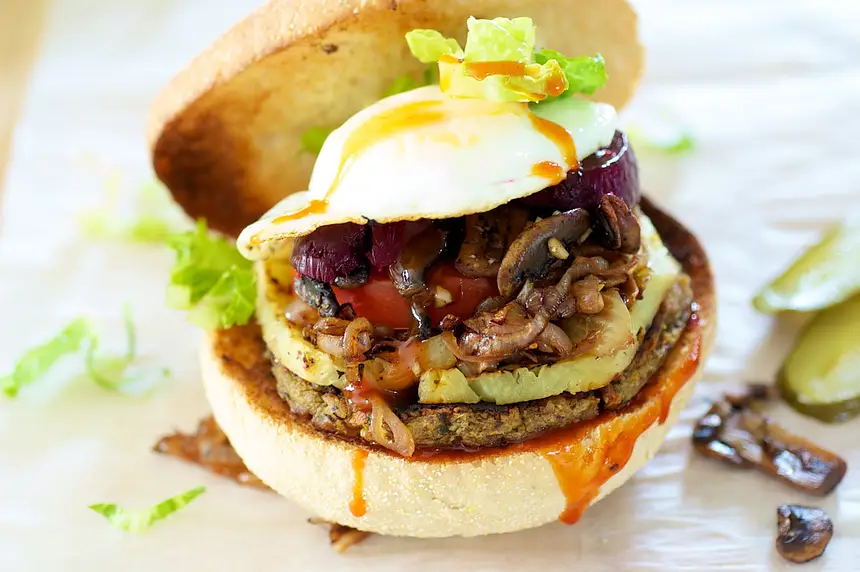
Australian Veggie Burger


This vegetarian burger is layered with grilled pineapple, caramelized onions, sauteed mushrooms and roasted beets with a slice of juicy steak tomato and some shredded lettuce on top. It delivers the most delicious veggie burger ever!
Rancheros
Rancheros are stuffed burger patties filled with American cheese and Ortega chiles, double-dipped in buttermilk and cornmeal, fried crispy, and topped with an easy-over egg.

Mexican Brunch Tortillas
Mexican brunch tortillas folded around soft-scrambled eggs, soy patty crumbles, melty pepper jack, and topped with chopped avocado and salsa. A vegetarian handheld brunch ready in 20 minutes.
McDunnah Burgers
Grilled burger topped with creamy guacamole and melted Monterey Jack cheese on a toasted bun. A simple Mexican-inspired twist on a classic hamburger.
Drive-In Nut Burger I & II
Two versions of the classic drive-in nut burger: one topped with salted peanuts, American cheese, and Thousand Island, the other slathered with chunky peanut butter and Russian dressing. Retro burger bliss.
Drive-In Nut Burger I & II
Two versions of the classic drive-in nut burger: one topped with salted peanuts, American cheese, and Thousand Island, the other slathered with chunky peanut butter and Russian dressing. Retro burger bliss.
Chile-Head Patty Melts
Double-stacked burger patties stuffed with green chiles and chipotle puree, topped with Monterey Jack and smoky chipotle mayo. Not for the faint of heart.
Steak Au Vin
Pan-seared strip steaks in a rich Burgundy wine and brandy reduction with shallots, Dijon mustard, and fresh herbs. A romantic French-inspired steak dinner for two, ready in 30 minutes.