What Are Long beans and How Can I Use Them?
Long beans is easier to cook with than it looks. Here's how to choose, use, and store them, what to substitute, and 9 recipes to get you started.
Key Points
- Foot-long Asian pods, actually a cowpea relative of black-eyed peas, not a true green bean.
- Deeper, more savory flavor and a dense, chewy texture that survives high wok heat.
- Best dry-fried or stir-fried hot and fast; cut into 2-inch lengths first.
- Undercooked long beans taste grassy and squeaky, so cook them fully through.
- Green beans are the everyday swap; store long beans in the crisper and use within 3 to 4 days.
What are long beans?
Long beans are exactly what the name says: slender green pods that grow a foot to a foot and a half long, sold coiled or tied in loose bundles at Asian markets. They go by yardlong bean, Chinese long bean, snake bean, or asparagus bean.
Despite the look, they are not green beans at all. Botanically they're a cowpea, the same family as black-eyed peas.
The flavor runs deeper and more savory than a green bean, with a faint earthy, almost mushroom-like note. The texture is denser and a little chewier, and it holds up to high heat without going limp.
Cooking With Long Beans
Long beans were built for the wok. Their dense flesh shrugs off the fierce heat of a stir-fry, staying snappy where a green bean would wilt, which is why they're a fixture in Thai and Chinese cooking.
Snap or cut them into 2-inch (5 cm) lengths first. Unlike green beans, they don't really steam well; their texture turns out best when blistered hot and fast, either dry-fried in a near-empty wok until the skins wrinkle, or stir-fried with garlic and a salty-savory sauce.
On Recipeland they get blistered in Stir-Fried Longbeans, get tossed raw and pounded into a Thai green papaya salad alongside Mahogany Chicken Wings with Green Papaya Salad, and stand up to bold heat in a Jungle Curry (Kaeng Paa Moo). They also turn up chopped through Fried Rice with Basil.
Pairing and Common Mistakes
Long beans love assertive partners: garlic and ginger, chiles, fermented soy and fish sauce, and proteins like shrimp or minced pork. Sichuan dry-frying with a little chili and preserved vegetable is one of the best things you can do with them.
The most common mistake is undercooking. Long beans need to cook all the way through; raw or barely-cooked, they taste grassy and squeaky and can be hard to digest. Get real char or full tenderness on them, not a quick blanch.
What to Use Instead
Regular green beans are the everyday swap. They're milder and more watery, so cook them a touch less and expect a softer, juicier result rather than the long bean's chew.
Haricots verts work in a pinch but are even more delicate. For a stir-fry where texture matters most, Chinese broccoli stems or even asparagus give you a similar snap, though the flavor shifts.
Buying and Storing
Pick long beans that are firm and flexible, with a deep even green color. Pass on any that are limp or covered in bulging seed bumps, which signal an older, more fibrous pod.
They're more perishable than green beans. Store them unwashed in a loosely closed bag in the crisper drawer and use within 3 to 4 days, since the tips dry out and the pods go rubbery quickly.
Don't bother freezing raw long beans; they turn mushy. If you must store longer, blanch them briefly first, then freeze for up to a few months.
Quick facts
- In Chinese
- 长豆角
- British (UK) term
- Long beans
- en français
- haricots longs
- en español
- ejotes
Recipes using long beans
There are 9 recipes that contain this ingredient.
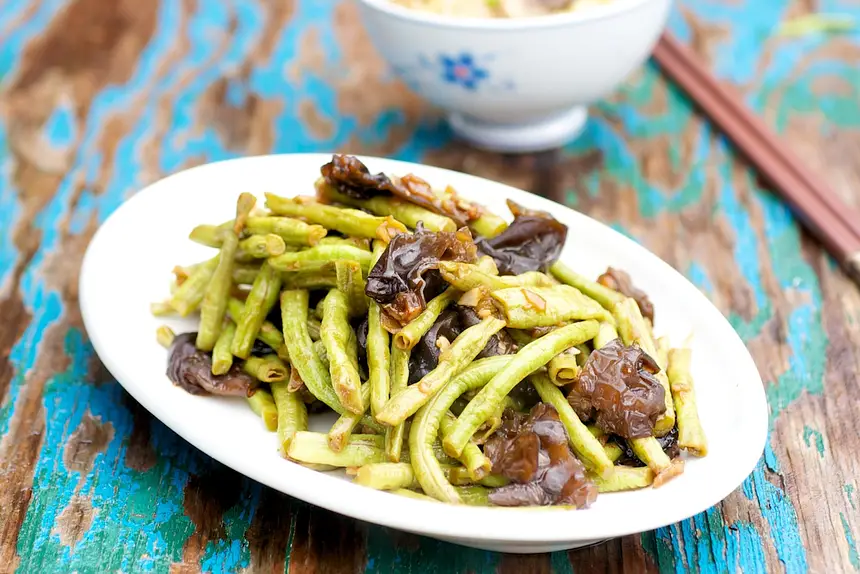
Stir-Fried Longbeans


Chinese longbeans stir-fried with cloud ear fungus, silk squash, shallots, and ginger in an oyster sauce and rice wine glaze. Swap in green beans and zucchini if you can't find the Asian varieties.

Som Tam (Green Papaya Salad) (Salads)
The health benefits of green papaya exceed those of the ripe variety. Raw green papaya is packed with vitamins, enzymes and phytonutrients. It contains vital nutrients including potassium, magnesium, and vitamins A, C, E and B. However, perhaps the most important health property of green papaya is its ability to improve digestion and the uptake of nutrients, raising enzyme levels and improving assimilation, and thus also strengthening the immune system. Green papaya contains two of the most powerful plant proteolytic enzymes: papain and chymopapain. These enzymes excel at breaking down proteins, fats and carbohydrates, as well as aiding healthy digestion. Papain can only be found in the papaya fruit and is more effective than pepsin produced by our own stomachs.

Mahogany Chicken Wings with Green Papaya Salad
Mahogany chicken wings lacquered with hoisin, plum sauce, and soy until glossy dark brown, paired with bright Thai-style green papaya salad. Bold sweet-salty-tangy contrast for a party platter.

Fried Rice with Basil
Thai basil fried rice with fresh red chilies, button mushrooms, long beans, and light soy sauce. A vegetarian wok-fried rice that's spicy, aromatic, and ready in minutes.
Nam Prik Curry Noodles (Kanom Jin Nam Prik)
Thai kanom jin nam prik curry noodles built on a fragrant coconut-moong bean sauce with red curry paste, tamarind, and crispy fried shallots and garlic. Rich, tangy, and earthy, served over soft rice noodles with long beans and sprouts.

Lemon Grass Spicy Vegetables
Thai lemongrass stir-fry with crispy fried tofu, long beans, broccoli, and a fresh-pounded chili-galangal paste. Vegetarian Thai vegetable dish with bright aromatics and real wok heat.

Noodles with Vegetable & Curry Sauce (Gueyteow Pak)
Gueyteow Pak, Thai noodles with blanched vegetables and a coconut red curry sauce with tamarind and crushed peanuts. A vegetarian Thai dish garnished with crispy fried potato rounds.
Jungle Curry (Kaeng Paa Moo)
Thai jungle curry (kaeng paa) is the fiery, coconut-free curry, a brothy, herbaceous bowl of pork, eggplant, and long beans simmered with curry paste, kaffir lime, and basil. Light, intense, and ready fast.