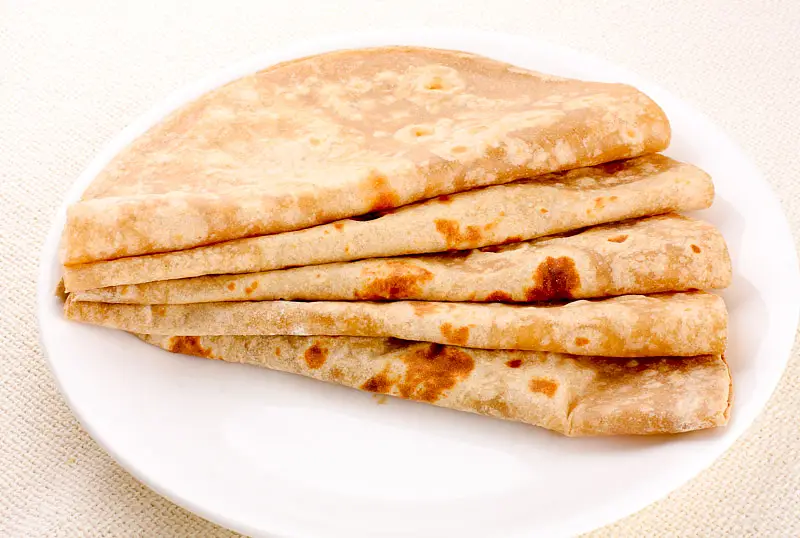
Whole Wheat Chapatis


Submitted by sreece
Whole wheat chapatis are unleavened Indian flatbreads cooked on a hot griddle. Five ingredients: flour, whole wheat, salt, ghee, water. Optional open-flame puff for the authentic balloon effect.
YIELD
10 servingsPREP
35 minCOOK
40 minREADY
2 15 minWhole wheat chapatis are the daily flatbread of Indian kitchens, the kind of bread that gets folded around curry, scooped under dal, or torn and used as an edible utensil. Five ingredients, no yeast, no rise time strictly required.
The blend of all-purpose and whole wheat flour gives these chapatis a softer texture than the traditional 100% atta version. Indian cooks use atta (a finely milled durum wheat) which is hard to find outside South Asian markets, so the AP-and-whole-wheat blend is a smart Western workaround that produces a similar suppleness.
Ghee (clarified butter) gives the dough its richness and helps it stay soft after cooking. Three tablespoons works into the flour like biscuit dough, then water brings it together. The kneading is what determines the lightness, the recipe is right that 10 to 15 minutes of work directly translates into more tender bread.
The puff over an open flame at the end is the signature move. A flat chapati is fine; a chapati that balloons up is one with the right hydration and skill.
Pro Tips
- Rest the dough for at least an hour, ideally overnight in the fridge. The rest hydrates the flour and relaxes the gluten, both of which produce lighter, more pliable chapatis.
- Get the griddle screaming hot before the first chapati hits it. A cool pan steams the dough and produces tough, chewy bread instead of light, blistered.
- Roll evenly and thin (about 5 inches across). Uneven thickness means parts overcook before others are done.
- Brush the cooked chapatis with a little extra ghee for a soft finish and a beautiful glossy sheen.
Variations
- Use 100% whole wheat (atta) for a more rustic, traditional Indian chapati.
- Stir a teaspoon of nigella seeds or ajwain (carom) into the dough for an aromatic twist.
- Brush with garlic butter just off the heat for a quick garlic naan-style flatbread.
Ingredients
Directions
Mix flours, salt, and butter and add just enough water to make a firm dough, somewhat like a biscuit dough.
Knead for 10 to 15 minutes - the more the dough is kneaded, the lighter the bread will be.
Shape the dough into a ball, cover with a sheet of plastic and let it rest for at least 1 hour.
If left to rest overnight in the refrigerator, the finished bread will be even lighter.
When ready to bake, take a small piece of dough about the size of a golf ball, or a bit smaller.
On a lightly floured board, roll the dough into a thin circle, about 5 inches in diameter.
Repeat with all the dough.
Heat a griddle or heavy-bottomed iron skillet until it is very hot.
Place the rolled out chapati on the griddle and let it cook for 2 to 3 minutes, depending on how thin you have rolled it.
Using a pair of kitchen tongs, you can lift the chapati to see if the underside has turned a golden brown.
Flip, and cook the other side about 1 minute.
As they are cooked, store the chapatis on a towel in a warm covered container until ready to serve.
Serve as soon as the last chapati is baked.
NOTE: In India breads sometimes are baked in the fiery clay tandoor, where they develop brown spots and bubbles.
To achieve a similar effect at home, you can use tongs to hold each chapati over a hot gas flame until it puffs like a little balloon.
The chapati will collapse as it cools.

Comments


